Streaming Video Drowns Itself By Flooding The Zone

Netflix is making big changes

I’m old enough to remember when it seemed like all of sudden, seemingly overnight, everyone owned a VHS machine. Sure, some owned a BetaMax, but VHS was the thing. Video rental shops popped up everywhere and we’d see our neighbors there more frequently than at the grocery store, browsing the titles.
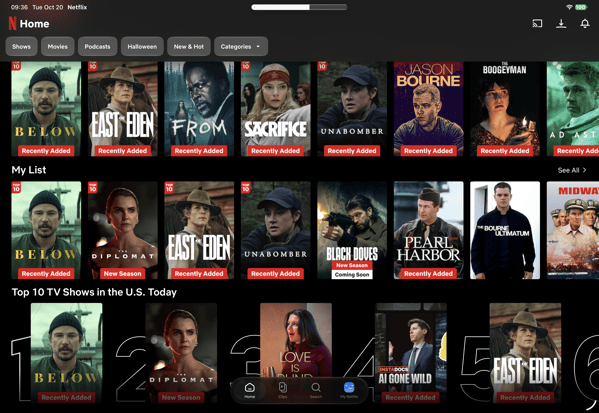
a screenshot of the Netflix home screen on an iPad. It displays rows of movie and TV show titles, including "Below," "East of Eden," and "The Diplomat," under categories like "My List" and "Top 10 TV Shows in the U.S. Today."

There was an old barn at the far end of the town that had sat empty for ages on a narrow, overgrown with honeysuckle corner curve in my small country hometown for ages. In the age before pop-up stores became popular someone popped it open as a video store, creating one of the first congested traffic nightmares that town had ever seen as folks parked along both sides of the shoulderless curve to rent a video.

Whether it was the local mom and pop video rental shop or later the BlockBusters, the display racks were bulging with titles. You’d walk in and be overwhelmed with the choices. To a degree that was the point. Flood the zone with more possibilities than anyone could keep track of to keep customers coming back. There may have been a pony or two in there, but eventually you realized that most of what was on the shelves wasn’t worth your time or money and the off the road parking on the curve eased.

When the next big hit finally made it into stores, the curve got crowded again as the aisles would fill up again while folks browsed, waiting for someone to return what they were really after, endlessly reading and rereading plot descriptions on the backs of boxes, hoping they were next on the waiting list.

VHS tapes became disks. Then along came Netflix.

Once Netflix moved into the video rental by mail business everything changed and the pop-ups pooped out, the video rentals that had become prevalent in grocery stores, pharmacies, and just about any other store that had a smidgen of floor space to offer them faded, and eventually so too did the big chains. The honeysuckle eventually reclaimed it’s territory.

And then along came streaming and the zones really flooded.

If you browse any of the streaming websites or apps today it’s like walking into one of those extinct video stores. Title card after title card scroll by in a waterfall of numbing repetition, often with the same title repeated line after line, category after category, too often in a weird trend that some marketing maven landed on of changing the cover art, hoping to get your eyeballs to land on a new image. It’s the same flood the zone approach.

When you flood the zone, eventually those you hope to lure in tire of treading water and turn their attention elsewhere. It happens in every sphere of human commerce, politics, art, music, you name it. Too much of a good thing becomes a problem when everything is just, well too much.

Now that just about every streaming service offers the same titles with the same upsell it’s overwhelming to the point of overdone.

I took the above trip around a winding corner curve in my memory lane after seeing news that Netflix, the company that changed it all by first flooding mailboxes and then streaming is wading into trouble waters. According to that article “user engagement has stalled due to a lack of popular content.”

There are many factors, but in my view that translates into an overabundance of quantity, not enough quality. There are big changes afoot as Netflix has fired Dan Lin, the head of its film division, along with six percent of its employees.

Netflix isn’t alone. It’s always been a leader, and leaders falter and flounder just like the rest of the pack. I certainly can’t say any of its competitors are that much better, but to my mind Apple TV has put out the best quality this year. After the Paramount/Warner Brothers merger that resulted in Skydance, with its promise of more movies each year who knows what the future will yield. I doubt quality will be the result.

That said, we started watching the 4th season of The Diplomat last night on Netflix, and it’s excellent. So there are gems that occasionally surface.

As all of the streaming services try to offer more, whether that be sports, or gaming, or just more of what the algorithm says enough want, they actually end up providing less, because the quality can too easily get swallowed in the flood zone.

It’s a tough job to program. As someone who has programmed seasons for live theatres I know you miss as much or even more often as you hit. It’s easy to get trapped into a formula when you find success. I’ve been there. It’s much harder to understand when a successful formula begins to fade. But when you focus on producing more rather than producing better, it’s easy to become mediocre, or worse, boring.

Rising prices and ridiculously programmed ad insertions certainly don’t help Netflix or any of its competitors either. Eventually it all becomes as numbing as the waterfall of titles that scroll down screens, like all of those titles on all of those old video store shelves. What quality there is too easily gets lost, even with the hype of a new release, when viewers have to wade through a flood of content that all looks the same.

Thanks for reading. You can subscribe to this blog if you care to. You can also find more of my writings on a variety of topics on Medium at this link, including in the publications Ellemeno and Rome. I can also be found on social media under my name as above. This site does not use affilate links.


Where’s Wanda? Is Worth A Watch

Good laughs to be had in this screwball black comedy.

Where’s Wanda on Apple TV+ is certainly worth a watch but it also begs the question my wife asked after we concluded viewing the first season, “where was the advertising and marketing for this show?”

Perhaps we missed whatever short marketing window Apple opened for the series, but it escaped our radar, and we only recently stumbled on it at the tail end of our queue by accident. Regardless, as I said, it’s worth a watch, especially if you’re in the mood for some good laughter.

Where’s Wanda? is a German language streaming series written by British writer Oliver Lansley, and directed by German director Zoltan Spirandelli. It was and is marketed as a black comedy, but I think black screwball comedy is more appropriate. Yes, there are subtitles. They also have some fun with that throughout.

The Wanda of the title is a young teenage girl gone missing and the plot ends up involving not only her family but their entire small town in searching for her. While the family drives the story, they guide us through enough of the town to be charmed and amused by the folks we meet with both recognition and surprise, as the plot evolves and involves more and more of the town in its mysteries.

The cast is uniformly excellent and I especially thought Heike Makatsch as the mother was superb. The moments between the younger cast members were some of the most engaging, hilarious, and touching scenes about the awkward moments in young people’s lives I’ve seen in a while. Where’s Wanda? gets silly, it gets serious, and it gets under your skin because of excellent work all around by the team that put it together.

You can find more of my writings on a variety of topics on Medium at this link, including in the publications Ellemeno and Rome. I can also be found on social media under my name as above. 

Sound and Fury with Apple TV Enhance Dialogue

Apple TV’s Enhance Dialogue works well until it doesn’t.

Apple introduced a feature I was very much looking forward to trying out this fall for tvOS 18. It’s called Enhance Dialogue. The theory behind the feature is simple: enhance the dialogue of what you’re watching so you can hear it. When my wife and I initially tested it we were quite pleased with the feature. But last night there was some weirdness.

Like so many features Apple (and others) release, new things seem to work out of the box. But then as updates rollout and things burn in, a bit of oddness creeps in.

Last night we were watching the finale of the Apple TV+ series Disclaimer. Things were rolling along just fine and then towards the end of the episode we stopped hearing dialogue. Characters became silent film stars and mimes with moving mouths, but no sound of dialogue was coming out. Underscoring continued.

Initially we thought this might be an artistic choice (a poor one.) What was happening in the story as it headed to its conclusion and then denouement could reasonably be understood without dialogue. But a tertiary character behind a nurse’s station uttered one line of dialogue, breaking the silence, and then immediately we went back to a silent film again.

I shouldn’t say completely silent. Background noises and conversations from background characters were coming through as ambience over the underscoring. Then a few moments later we heard some of the dialogue, but it was muffled and echo-y as though picked up by a distant microphone or layered on top in post of what we were supposed to be hearing. Every now and then we’d occasionally get those clear, one line bursts of dialogue. The conclusion I reached after this whole thing was over is that those lines in the clear must have been overdubbed and the muffled lines were due to be enhanced later.

We paused the episode and I turned on subtitles, revealing that there was indeed dialogue being spoken. We stopped the episode and tried again. Same result. I then went back to settings and turned off Enhance Dialogue. Voila. We were able to hear all the dialogue again.

I know lots of things are going on in the backend at Apple has they continue to roll out betas at a crazy pace trying to play catch up in the Artificial Intelligence game. I’ve written before on how this can have an effect on even non-beta users. What’s puzzling to me is that this doesn’t seem like a feature that should be affected by backend services. Perhaps I’m wrong. But we’ve watched several shows without this issue since first turning on Enhance Dialogue.

Here’s the thing. In my opinion, both the visual and audio elements of film making have pushed new technology envelopes a bit too far. We shouldn’t need a feature to enhance dialogue to overcome bad sound mixes that try to be as realistic, or unrealistic, as possible in the same way that we should still be able to view actors in dark scene. If you can’t see or hear the story, what’s the point of the story, or the technology? Sound and fury signifying not much.

Then again, I get it. Artists will tell you they are trying to make things look and sound as real as possible, or craft an environment that is all encompassing with all of the elements at their disposal. Too often they get carried away and lose us to ineffective story telling.

I had planned to write up a blog post saying how much the Enhance Dialogue feature was a winner after some success with the new feature. I can’t say for sure that there is direct causation between the new Enhance Dialogue feature and the dialogue dropout we experienced. I will say, that it’s easy to point a finger of correlation after new features are released and something, anything goes awry. For now, I’ll leave it as the Enhance Dialogue feature looks like it could possibly be a winner in our household. If it works as advertised. All the time. Every time.

I will also say again that if filmmakers did their jobs correctly this wouldn’t be necessary except for those watching who might need assistive technology. In my opinion, if story tellers start relying on this feature to be present (I know it exists on many smart TVs,) it will be to the detriment of their craft and artistry.

You can find more of my writings on a variety of topics on Medium at this link, including in the publications Ellemeno and Rome. I can also be found on social media under my name as above.