
It seems we’ve reached a societal technology moment, backing ourselves into a Catch-22. Joseph Heller probably wouldn’t touch this new one, because he already did.
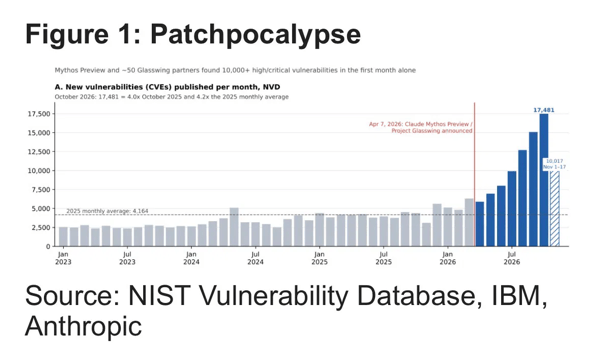
After a series of almost daily disruptions to airlines, parts of the banking systems, the NSA, Microsoft and Apple’s cloud services, calling things chaotic would be spot on but also misses the point. To call the problems what they are is another thing altogether. Fixing them will prove as slippery as catching an eel in a grease pond.
The conventional wisdom that seems to be emerging is that updating and patching software systems, apparently replete with bugs and security holes beyond what humans could discover or couldn’t find the time to fix, but that AI could, has guess what — caused other problems. Who knows if that will hold, or if it’s even true. But those, except for the bumblers in the White House, who are in positions to guess seem to think that’s the best explanation. Or at least the best explanation the public will swallow.
According to FedWatch, (where the graphic above is from and who I think coined the word “patchpocalypse”) AI bug hunting uncovered a record 17,481 bugs in October.
What the general public is beginning to grasp is that the same apprehension everyone feels when they update their computer or smartphone, typically accompanied with the innocuous, incomplete, and inexcusable lack of an explanation that it fixes bugs and increases security, is that whether it’s an iPhone or a complex system that governs sectors of the economy, success is closer to predicting a coin flip than it is flipping a light switch on and off.
The push has been to accelerate AI to find and fix problems. The law of putting your hand on a hot stove top leads me to bet there’s going to be a pull to slow things down if the emerging conventional wisdom about the last week holds.
All of this comes after living through a series of warnings (or marketing hype?) that AI is going to bring about the end of humanity and the world watching unnecessary wars, piled side-by-side with increasing concerns about AI taking jobs and gobbling up communities with data centers. Although there was considerable pushback on data centers in the recent US elections, I doubt that’s a signal that AI robots crawling the Internet understand, given that it’s not in the robots’ or their masters’ best interests.
If AI is moving faster than our ability to use it to successfully mitigate problems without causing more, and perhaps more dangerous problems. it begs the question as to what’s the point?
That’s really not a serious question for serious people because there are indeed serious problems that need to be fixed. The serious question for this serious moment is this: We’re here now, how do we responsibly use these new tools to fix things we were too lazy to fix before AI, and how do we use this new technology to protect ourselves from the very same human insufficiencies that led us to this moment? I’m serious.
I’m certainly apprehensive about the possible paths that might lead out of this mess. Not because of AI, but because of the humans behind it. I don’t think anyone has coded greed and self-interest out of an AI yet.
I live in Chicago. Potholes are a way of life here. Every Spring I watch asphalt patches applied to the same potholes that every winter freeze rips open again. It’s a farcical ritual. If AI could diagnose the problem and prescribe the fix I’m sure it would be the same as human road engineers, and those who drive the streets, have suggested for years. Tear it up and rebuild the road from scratch. No politician is going to vote for that, because no taxpayer is going to want to pay for it.
Honestly, I’m guessing this moment of using AI to correct the problems we’ve let linger for too long is just going to lead to a similar cycle down the road as we keep employing AI to patch the problems it creates in attempts to fix the laziness of the past.
We are only human after all. You can’t patch that.
Thanks for reading. You can subscribe to this blog if you care to. You can also find more of my writings on a variety of topics on Medium at this link, including in the publications Ellemeno and Rome. I can also be found on social media under my name as above. This site does not use affilate links.


@warnercrocker.com There will never be order in Chicago. I don't know why Seattle, which is much smaller than Chicago, spends a fortune on road infrastructure.
LikeLike
Remote Reply
Original Comment URL
Your Profile
Why do I need to enter my profile?
This site is part of the ⁂ open social web, a network of interconnected social platforms (like Mastodon, Pixelfed, Friendica, and others). Unlike centralized social media, your account lives on a platform of your choice, and you can interact with people across different platforms.
By entering your profile, we can send you to your account where you can complete this action.