
Blowing AI Smoke or Feeding The Fire

The pace is becoming impossible to track

This Artificial Intelligence moment we’re living through might seem like smoke and mirrors on some level, but it appears it’s going to be a trend that sticks. Even so, it sparks memories of a couple of recent crazes we’ve all lived through that are decidedly non-tech and some that are tech related.

Ruben bagues fe64iWwhoWs unsplash.

When vaping became a thing it seemed that every other person on the street was trailing a vapor cloud and quite a few were pushing the limits that had previously banned indoor smoking. When marijuana was legalized where I live it felt like we were all getting our buzz on whether we were lighting up or not. Driving down a street in Chicago, or even stuck in traffic on the expressways the tell-tale odor of “skunk” or whatever bud folks could get their hands on was everywhere.

The proliferation of gummies took care of most of the second-hand stench and dispensaries sprouted like wildflowers, leading one to wonder how long that trend will last before an inevitable consolidation occurs. But after all of the smoke the clouds of vapor eventually became as rare in public as the cigarette smoke they replaced.

I’ve seen a number of other trends in my life from pet rocks to tech gadgets. Remember netbooks? The rare ones stick. Most fade away, occasionally leaving enough residue to resurface again when nostalgia kicks in. Of course nostalgia on some meta level is a trend in and of itself.

But this AI trend we’re living through is taking on a life that depending on which Artificial Intelligence pioneer you talk to will make all our lives better or perhaps end them all. 

If you ask me, on one level this AI trend feels no different than the smart home trend. With enough tinkering you can install smart home appliances, lighting fixtures, cameras, thermostats, etc… but the not-so-dirty little home wizard secret is that no one has been able to figure out any sort of standard, much less a way to keep things reliably working once the next set of software or firmware updates arrive. So the cruft accumulates. Tinkerers have a blast. Regular Janes and Joes just go back to flipping light switches.

And we seem to be at the tinkering phase with AI. Which when you think about it, sort of makes no real sense. Because if you have to dig into the innards of a terminal app in order to make your computer run your computer, where’s the tinkering fun in that once it’s done and your computer(s) running your computer(s) can run your life and do all the tinkering for you?

A couple of pieces caught my eye recently that, to my mind at least, point out some of the conflicted thinking.  When you have a headline that reads The A.I. Disruption Is Here, and It’s Not Terrible, I’m not sure it bodes well. Then there’s We’re Not Just Receiving AI’s Hallucinations, We’re Hallucinating With It. Brings back whiffs of those early days of legalized pot.

But then I followed Steve Troughton-Smith’s thread on Mastodon where he used AI agents to port an iOS app to Android. There’s certainly utility there.

All kinds of issues from the ethical to the environmental remain and need to be sussed out, but I’m thinking this trend is accelerating faster than might be humanely possible to keep track of. Perhaps a series of AI agents could do that work. It’s funny to think that.

I certainly doubt anyone would be satisfied with that. But this rising trend has accelerated in an era where facts matter less than who has the louder narrative of the moment. I think it is telling though that Peter Steinberger, the developer who came up with the AI thing of the moment, OpenClaw, took the money and sought refugee under the OpenAI umbrella. I guess that’s one way to avoid any liability if his lobster bytes do some serious damage down the road.

Frankly, I’m disappointed that this has all morphed so quickly from a tinkerer’s technology trend into one that now seems to control too much of the world’s current and future economy, not to mention all of the other areas of life, business and government that everyone seems in such a rush to insert it into.

AI is certainly not vaporware. It may be on a fast rising trend, but it appears it’s one that will stick in some form or fashion. All trends are eventually defined by lines. They don’t spike up forever. Until some AI agent computes a way to avoid a dip in trend lines that no human has yet to figure out.

(Photo from Rubén Bagűés on Unsplash)

You can also find more of my writings on a variety of topics on Medium at this link, including in the publications Ellemeno and Rome. I can also be found on social media under my name as above.

 

AI Agents Are Writing Blogs Now

A real human works here

At some point we won’t be able to tell what’s what or who’s who.

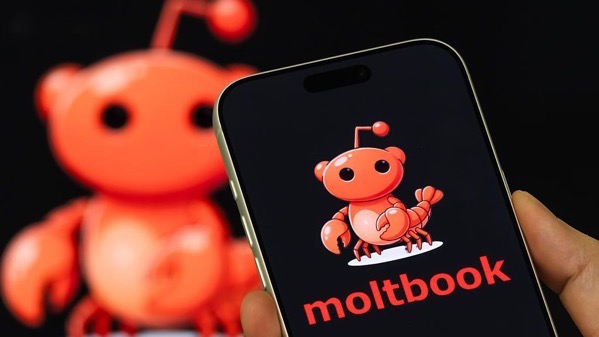
A graphic of Moltbook, the website for Ai Agents

You can argue we’ve reached that point in real life given the propensity to push lie upon lie for political and economic gain. You can also argue we were fast approaching that point with Artificial Intelligence and AI agents that can write poems, plays, papers, and who knows what else.

Perhaps even a blog post. (For the record, this one is written by a very real human, flaws and all.)

Mark Sullivan, writing for Fast Company, tells the tale of an AI agent that autonomously wrote a blog post attacking a human for not allowing it to release some code.

Matplotlib, a popular Python plotting library with roughly 130 million monthly downloads, doesn’t allow AI agents to submit code. So Scott Shambaugh, a volunteer maintainer (like a curator for a repository of computer code) for Matplotlib, rejected and closed a routine code submission from the AI agent, called MJ Rathbun.

Here’s where it gets weird(er). MJ Rathbun, an agent built using the buzzy agent platform OpenClaw, responded by researching Shambaugh’s coding history and personal information, then publishing a blog post accusing him of discrimination.

Here’s a link to the AI agent’s blog.

Here’s a link to Scott Shambaugh’s post about it called An AI Agent Published A Hit Piece On Me.

On the one hand, the situation is comical. On the other, it just continues to be a large slap upside all of our heads, begging us to wake up and asking us just what the hell we are doing?

You can also find more of my writings on a variety of topics on Medium at this link, including in the publications Ellemeno and Rome. I can also be found on social media under my name as above.


Watching Others On The Digital Frontier

Lobsters, doctors, and spreadsheets

At one point space was the familiar final frontier. Even with talk of putting data centers in space, I dare say we’ve moved the concept of frontier closer to terra forma and set aside the “final.” Frontiers require explorers who are willing to accept risks, pushing beyond them to discover if there’s any there there. Maybe we’re in the moment of redefining “there.”

Shutterstock 2698519847.

I’ve been curiously watching recent developments on the frontiers of Artificial Intelligence around what was launched as Clawdbot, then became Moltbot, and molted into OpenClaw. At least I think that’s what it is still called as of this writing.

For those unfamiliar, essentially OpenClaw is an AI agent created by software engineer Peter Steinberger, that receives instructions from the user in a chat. Running locally on your computer it then connects to other AI sources and web based apps you give it permission to access. It performs those tasks and actions. Mike Elgan has a good rundown on the (brief) history and the ins and outs. I encourage you to read it.

Both fascinating and frightening, OpenClaw seems to have taken on a life of its own without any regard for guardrails. After Federico Viticci wrote an early post about what was Clawdbot at the time, interest shot through the roof, reminding me quite a bit of the furor over the still recent launch of ChatGPT and just about any other big computing innovation we’ve seen.

Quite a few jumped in with both feet to test the waters. Alongside of all of the splashing around came upfront real warnings that this thing was not secure. That proved to be even less effective than signs telling you not to run around the pool. Viticci mentioned that given security concerns the project was not really ready for everyday users, and recommended that those interested install it on a second computer, not their main one. Apparently there was even a run on Mac minis.

The promise seemed clear and the hype leapt into hyperspace. OpenClaw would become the user’s personal assistant doing whatever was required. That’s been the as yet unrealized promise so far in all of these AI adventures.

The moment continued to evolve to a point that there’s even a social network called Moltbook where these AI bots could talk with each other. (Sounds like Mark Zuckerberg’s dream.) Mathew Ingram writes about that here, linking to Simon Willison’s post Moltbook Is The Most Interesting Place On The Internet Right Now.

At the time of Mathew’s post there were 1.6 million agents participating. Not to spoil his article, which you should read, there is some doubt as to whether or not there are humans doing mischievous human things behind the scenes. (Again, sounds like Zuckerberg’s dream.)

Casey Newton gave it a try. Still Moltbot at the time of his writing, he fell in love and out again, eventually uninstalling the software saying that “maybe someday you’ll have a genie in your laptop working for you 24/7. Today is not that day.”

That reminded me of all of the users who said that ChatGPT would replace Google for all of their search needs in that first explosive week. It appears that though the excitement and hype is still boiling hot, not everyone is ready to be the chef that tosses the lobster in the pot.

On other fronts

Before all of the OpenClaw news became the main course of the moment there was another very interesting AI story that caught my attention.

Since January 7th, Apple Health users have been able to connect ChatGPT to Apple Health. Geoffrey Fowler gave it a try.

Like many people who strap on an Apple Watch every day, I’ve long wondered what a decade of that data might reveal about me. So I joined a brief wait list and gave ChatGPT access to the 29 million steps and 6 million heartbeat measurements stored in my Apple Health app. Then I asked the bot to grade my cardiac health.

It gave me an F.

I freaked out and went for a run. Then I sent ChatGPT’s report to my actual doctor.

The good news is Fowler was OK and his doctors told him to relax. The concerning news is that one of the promises of AI is that it would help with medical diagnosis and be a boon to patients and doctors alike.

Now, certainly Fowler’s experiment is different than what may happen under stricter supervision and stringent testing. And, as he points out, OpenAI and Anthropic say their digital doctor bots can’t replace the real thing and provide big bold disclaimers.

Fowler’s experiments didn’t stop short with his artificially intelligent failing grade. You should read the article to see how the adventures continued. Suffice it to say, the conclusions (not just the medical ones) currently leave much to be desired.

Then this morning I stumbled across this article from Om Malik called How AI Goes To Work. It’s a great story about how one user found a way to solve a problem he has with spreadsheets using AI. It also provides some great tech history context and leads to an opinion I share about where we are today:

My simpler explanation of “embedded intelligence” to myself makes me step away from the headlines and look at the present and the future in more realistic terms. My bet is that in five years, it will all be very different anyway. It always is. I am a believer in the power of silicon. When we have newer, more capable silicon, and more networks, we will end up with ever more capable computers in our hands. And the future will change.

For now, what I call embedded intelligence is a sensible on-ramp to the future. The hype may be about the frontier models. The disruption really is in the workflow.

As I said, I concur with that opinion and it colors all of my current observations of the AI landscape. Be curious and become informed. I go further and say I’m comfortable letting others take the first leap.

I don’t think there’s any denying that most of us would enjoy living in a world when we could sit down with our computing devices, talk to a pendant, or even the air around us, (anything without the name Siri preferably), wish the world a good morning, and have it spit out not only our tasks for the day but do many of those for us. Folks of my generation grew up on Star Trek and other science fiction where this seemed common place. So too, did the problems and catastrophes when circuits got crossed or corrupted.

So, it’s a new frontier. Maybe the final one. Maybe not. But at the moment, we’re still just humans crossing into it. Forget what the bots may eventually do to us. I think I’m more concerned about the humans.

(image from kentoh on Shutterstock)

You can also find more of my writings on a variety of topics on Medium at this link, including in the publications Ellemeno and Rome. I can also be found on social media under my name as above.