Apple has wrapped up its WWDC 2024 keynote address unveiling a number of new features for most of its platforms and devices. The wraps were also taken off of Apple Intelligence, Apple’s move into AI. I’m still processing all that was talked about, but here’s a short video summary Apple released.
Who knows which AI engine Apple used to create this, or if it was done the old-fashioned way.
You can find more of my writings on a variety of topics on Medium at this link, including in the publications Ellemeno and Rome.I can also be found on social media under my name as above.
A reading list of predictions and commentary heading into WWDC 2024.
There are always lots of predictions about what Apple will announce at its annual World Wide Developer’s Conference each year and this year is no different. I’ve written a few of them myself. Here’s a quick list of some pieces from others and myself that I think provide a good pre-WWDC reading list.
Gurman also expands on his thoughts about Apple Intelligence here.
As a companion to that check out John Gruber’s take on Gurman’s Epic Pre-WWDC Leak Report. Gruber seems to think it’s indeed a leak and the folks inside Apple aren’t too happy. IYKYK
Since Artificial Intelligence, or as it appears soon to be christened Apple Intelligence, seems to be the order of the day, Craig Grannell has some intriguing thoughts on how Apple can avoid the pitfalls others have made in this great AI gold rush.
It’s always interesting to see what comes out of each year’s WWDC announcements because one way or the other they set much of the agenda for the next year and beyond.
You can find more of my writings on a variety of topics on Medium at this link, including in the publications Ellemeno and Rome.I can also be found on social media under my name as above.
It’s time to share a little Sunday Morning Reading. Words on Apple, words on politics, words on loss, and some words on photography. Read some words.
This week Apple will hold its annual World Wide Developer’s Conference (WWDC) focusing eyeballs on Cupertino and what everyone expects to be Apple’s big push into the Artificial Intelligence game, now looking like Tim Cook’s version will be called Apple Intelligence. This has been no secret for quite some time. That said, Mark Gurman of Bloomberg seems to have gotten quite a few of the details, whether leaked or planted who really knows, on what’s about to unfold. Check out Here’s Everything Apple Plans to Show at It’s AI-Focused WWDC Event.
As a companion to that check out John Gruber’s take on Gurman’s Epic Pre-WWDC Leak Report. Gruber seems to think it’s indeed a leak and the folks inside Apple aren’t too happy. IYKYK
As I stated the focus will be on AI. I’m thinking it will be just as hard to cleanly view where this is all headed as it has been with announcements from other companies, given that no one has nailed down an AI or LLM that seems to live up to the promises or provide reliably accurate answers. Check out Google’s and Microsoft’s AI Chatbots Refuse to Say Who Won the 2020 US Election by David Gilbert.
Natasha MH has penned a lovely piece about the lives we cherish and the ones taken from us with Weeping For Relationships Made Out of Dreams and Denials. There have been lots of dreams and denials dashed in this last decade. Some very personal and some quite global.
In many ways, Natasha’s piece linked above is a a companion to this David French piece The Day My Old Church Canceled Me Was a Very Sad Day. We’ve gotten far to used to loss and far too accepting of how we’re experiencing so much of it because of the turmoil visited on us by one orange-tinged demagogue. Brenda Wineapple says this is Trump’s Most Dangerous Gift., and that it will never rise to the level of public tragedy. If that’s the case, nothing ever will.
We think it’s all happening to us in the here and now. But while today’s issues are horribly threatening and provoke chatter of Civil War, we’ve had our share of the same from our past. Jon Grinspan takes on a bit of a tour of some long forgotten American history that actually led to our actual Civil War with Long Before the Woke, There Were The Wide Awake.
And as a final Sunday morning palette cleanser check out The 25 Photos that Defined the Modern Age in a piece put together by M.H. Miller, Brendan Embser, Emmanuel Duma, and Lucy McKeon. The pictures are worth thousands of words but the words accompanying the pictures are worth quite a bit as well.
If you’re interested in just what the heck Sunday Morning Reading is all about you can read more about the origins of Sunday Morning Reading here. You can also find more of my writings on Medium at this link, including in the publications Ellemeno and Rome.
Bring in the new and shiny, but fix the old and buggy too.
The Internet is filled with wish lists of things Apple fans would like to see announced next week at WWDC. New things. New capabilities. New all round. The majority of those wishes are the same and focus ahead. Nothing wrong with that. We’re always advancing. Or so we’re told.
Perhaps I’m stuck in the past, but I’d rather see Apple devote time to correcting some longstanding issues that bug me. Many of these issues are part of the glue that holds Apple’s ecosystem together, or what Apple calls iCloud and I call the unnamed operating system, iCloudOS. So, I’ve compiled a list of things I’d like Apple to fix, repair, or at least pay some real attention to.
Chances are better than good that you won’t hear much about any of this next week or in the weeks that follow. Many of these issues have existed for a few years now and seem to be such a low priority that Apple must be content to let them exist. Quite a bit of this could be considered small in comparison to the bigger challenges brought on by adding new features that bring new complexity. But one of the reasons so many prefer Apple’s way of doing things is the attention to detail in both design and practical matters. When it’s good it’s great and often magical. When Apple loses focus and doesn’t pay attention it can be like watching a magician pull a dead rabbit out of a hat.
For me these issues are rough enough and present enough inconsistency to diminish that attention to detail. The longer they are ignored or put off the more they point to glaring weaknesses in Apple’s process and I think we get farther away from that “magical” or “it just works” lore.
It’s apparent that not enough others feel the same or have the same experiences to pressure Apple into devoting the resources necessary to address these annoyances. That’s not a surprise. New always takes precedence in a market driven by delivering something new each year. And AI is the big new thing this year and Apple has assigned all hands on deck to ready what most expect to be the newly christened Apple Intelligence ship to sail.
Yes, we’ll hear quite a bit about AI. I’m also sure we’ll hear about things like emoji, flashy Messages and other novelties that show well in demos. Many of those I consider trivial or “meh” features that will be forgotten shortly after all of the reviews are written. Though the money I spend on Apple products is a small drop in Apple’s buckets of cash, I’d much rather see it spent putting resources into fixes for these annoyances. The list below certainly isn’t a complete one, but these are the things I’d love to see Apple address.
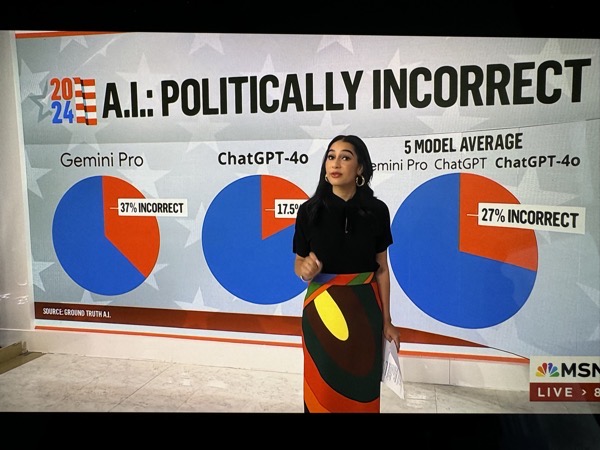
Artificial Intelligence is taking its beatings as it weaves its way into just about anything we think might give us a leg up. Recent misfires from Google and Microsoft after big announcements shed light on just how, to this point, reliably unreliable your AI of choice can be. On one hand it’s entertaining. On the other it’s concerning. If there was a third hand I think it would shake towards irony.
MSNBC ran a recent report highlighting inaccuracy scores when AI chatbots were asked political questions and came up with an average of 27% incorrect responses.
It seems to me that a 27% inaccuracy rate is probably within the ballpark of what we hear on any normal day from traditional news sources, social media, and folks sitting at the counter at the local diner. While there are certainly problems, it feels much like AI is doing what it’s designed to do: spit back the nonsense we feed it and it feeds on.
Frankly, I don’t think humans can design any piece of software that will outstrip our human capacity for ignorance that gobbles up the increasingly large amounts of garbage already available. As long as folks can make money from feeding us the fake alongside the real the churn will continue.
Addendum: After posting this I noticed this article in my feeds:
You can find more of my writings on a variety of topics on Medium at this link, including in the publications Ellemeno and Rome. You can also find me on most social media using my name.
iCloud OS: Apple’s Unnamed Operating System. The second in a series heading into Apple’s WWDC 2024.
WWDC is designed to highlight future directions for Apple’s increasing number of operating systems and how they work together. The OS list is long and getting longer, but there’s actually one that Apple has never mentioned as an operating system, yet it’s the one that glues every other piece of the ecosystem together. I call it iCloudOS. Like any glue it can fasten and bind, but apply it without care and you can end up with a sticky mess. iCloudOS is a bit of both.
If you use multiple Apple devices iCloud ties them all together creating a supposedly fluid connection between devices and services. That’s the attraction of the ecosystem. When it works as designed it can feel magical. Copy and paste between devices, universal control, handoff, shared Notes and Reminders and others all make Apple computing life more productive and often more fun.
When things don’t work it reminds every parent of raising a child. There are moments of sheer wonder and joy, but you know at some point the kid is going to shit the bed. There’s too much of the latter to ignore.
I’ve written extensively about my iCloud woes (here, here, here, here, and here). I’ve had numerous conversations with Apple tech support personnel. What I’ve discovered is that there are ongoing iCloud backend issues that Apple hasn’t been able to solve. They keep trying, but they keep getting put on the back burner once Apple gears up to roll out its next big new thing, as is the case with this year’s now well predicted AI announcement. Things reach a point when a “wait until next year” mandate takes hold that would test even a Chicago Cubs fan’s patience.
In my most recent adventures into the backend of iCloudOS it has been acknowledged that all of the work we were doing to pin down the issues I and others have been seeing has been put on hold until after whatever is coming next in the various operating systems due to be announced next week. All well and good, I suppose, but here’s the problem with that. That approach essentially makes all users of the ecosystem beta testers. I do not run betas on my devices but I’ll suffer through the numerous summer releases and whatever changes Apple makes on the backend during the summer beta season. That will continue with each point release throughout the year. Keep in mind, we’re all, always at the mercy of the backend.
I’ve already seen this begin to happen and the betas don’t roll out for a week or so yet. One of the early warning signs(and there are quite a few) that things are happening in iCloudOS is when notifications for Apple’s Reminders app get out of sync between my macOS devices and iOS devices.
Here it comes. Apple is heading into its annual World Wide Developer’s Conference (WWDC) with announcements of its next big things beginning June 10th. By all accounts, this year those next big things will center on AI which is short for Artificial Intelligence. There won’t be any shortage of AI in a tech world that has grown both AI crazy and AI fearful, putting Apple is in the unusual position of playing follow the leader in more obvious ways than in the past.
There will be other new features announced for iPhones, Macs, Apple Watches, perhaps even the Vision Pro, but as always the focus will be on what’s new. Even though a goodly portion of what’s new and exciting each year often ends up being a bit “meh” in the end. Either “meh” or rolled out and forgotten as Apple shifts its attention to what next year’s next big things will be. That seems to be what’s happening this year as Apple has turned most of its focus to AI.
Apple is also unfortunately positioned to have to work harder in making its splashy announcements splashy and dodging seemingly already diminished expectations on a number of fronts. Most anticipate Apple’s AI announcements to be less than sexy and the iPad faithful/hopeful seemed to be poised to continue piling on the criticism (some necessary, some not) that greeted newer iPads less than a month ago.
So, on two big fronts, AI and iPadOS, Apple has some tougher challenges ahead than it usually does this time of year. And bad timing is at the root of both.
The iPad Issue Is Touchy
On the iPad front, for whatever reason Apple went more than a year before releasing new iPads. When they did debut them last month they surprised everyone by including new M4 chips in the new Pro lineup, upsetting every pundit’s attempts at trying to assign a predictable timetable to the continued Apple Silicon evolution. Coming just weeks ahead of WWDC, and without any new operating system software to accompany it, Apple opened up a slew of doors for the salivating pundit class to rush through, cranking up the complaints about iPadOS not taking advantage of very powerful and much loved hardware. And, as always, the married at the hip debates about being able to run macOS on an iPad or adding a touch screen to the Mac tagged along as noisy bridesmaids.
It’s a bit frustrating for a regular and religious iPad user. While the issues are genuine, they negatively dominate the conversation given that they come from the influential voices that helped turn the iPad into a success in the first place. I know the issues are long simmering, well intentioned, and come from the heart of those who love the device, but the recent sudden crescendo was deafening enough to fire up a Loud Environment warning on an Apple Watch. With WWDC just around the corner everyone knew the new devices alone were not going to offer anything remotely close to a new and different iPad experience. It just seemed premature to me. If they were meant as a warning to Apple, then I would call it not only premature, but a misfire given the timing.
Those debates and complaints probably aren’t going to end in the foreseeable future as entertaining and exhausting as they can be. Between manifestos, and well thought through lists of what some desire on iPads, there was some general vitriolic piling on. It heralds a tough year ahead for Apple and its iPad lineup.
My prediction is that no one is going to be remotely satisfied with this year’s iPadOS release. Most rumors say not much of consequence will be announced. It’s certainly going to be interesting to follow the commentariat class as they wrestle with how many different ways they can say the iPads are great devices but Apple keeps holding them back for another year.
Perhaps this year changes things, but typically big OS changes come to the iPhone first with iPads and Macs bringing up the rear in the year or years that follow. Given Apple’s push into AI as this year’s big iPhone tent pole, if the iPad doesn’t get included it will add even more to those complaints and increase the volume.
The Alito Court may be about to repeat the mistakes of 2022.
History may be about to repeat itself. Hopefully it rhymes. Donald Trump is a convicted felon and he and his fluffers are doubling down on their attempts to manufacture a fantasy world that bears no resemblance to the one most people live in. Yet we’re still waiting a decision from the Supreme Court on whether or not U.S. presidents have immunity and thus are kings who can round up and possibly kill political rivals, deport anyone they desire, and generally turn the U.S into a autocracy staffed by criminals.
While that immunity case has no bearing on the New York case that added 34 convictions to the decaying orange turd’s résumé, it is all tied together because there’s this thing called an election in a few months wherein we’ll decide if America still exists as a democracy.
The Supreme Court hasn’t issued an opinion yet, which in and of itself is an opinion. In delaying action they’ve effectively sided with Trump, allowing any real chance of a trial to be pushed off until after the election. But unfortunately they have to make a decision before they can head off to their yachts for the summer.
What’s intriguing to me is I think the Alito Court is about to make the same political mistake they made in 2022 with their decision removing women’s rights to an abortion in Dobbs vs. Jackson. It was a victory for abortion foes, but energized the electorate enough to wash away any Red Wave in the 2022 elections and others that have followed since. My suspicion is if the Alito Court grants anything resembling immunity to Trump, we’ll see the same sort of rage-fueled energy at the polls in November. There’s enough of that energy already bubbling, but this might (should) blow the lid off the pot.
It’s June, SCOTUS is heading to the end of this term, and an announcement could come any day as the court traditionally rolls out decisions from the current term. The hen-pecked Alito is under fire for flying insurrectionist adjacent flags while blaming his wife, further degrading any sense of integrity the Supreme Court had remaining. I’m thinking (and hints suggest) the decision will be in Trump’s favor thus completely erasing what few bits of integrity still remain on the white board. If they do, it will hopefully ignite the electorate again to finally cancel this unreality show we’ve all been living through.
You can find more of my writings on a variety of topics on Medium at this link, including in the publications Ellemeno and Rome.
Secret octopi, culture wars, convictions, and reading between the letters. In this week’s Sunday Morning Reading.
Life is beginning to settle in after the big move, although there’s parts of it we still can’t figure out which box we packed some of it in. Perhaps we need some sort of A.I. bot to help us figure that out. But we’ll get there. In the meantime here’s some Sunday Morning Reading to share.
Speaking of AI, WTF is AI? That’s the question posed with some attempted answers by Devin Coldeway. It’s a decent primer on the topic. Watch out for secret ocotopi.
A couple of pieces on AI from Nico Grant at the NY Times shows just how unknown and perhaps reliably unreliable this fast evolving tech territory is. First up is Google’s A.I. Search Leaves Publishers Scrambling. Follow that up with Google Rolls Back A.I. Search Feature After Flubs and Flaws. I wonder how AI will spit all of this back at us once articles like these are trained in. I also wonder when publishers will start to standardize whether or not we’ll write it as AI or A.I.
Even in the midst of moving it’s been tough to ignore the political comings, goings and convictions in the news. Check out David Todd MCCarty on Bedtime for Bonzo, Or Nothing To See Here. Even after 34 convictions for the orange dude, this piece holds up.
This piece from July of 2021 by John Pavlovitz resurfaced in my feeds in the last week. The Sadness of Sharing A Country With Trump Supporters is worth a re-read in the wake of this week’s news. Somehow I think it will remain relevant for quite some time.
With all that is going on in the political world, it’s a good idea to always remember there is so much more going on behind the scenes than we ever want to realize. Check out Ken Silverstein’s look behind the curtain in Off Leash: Inside The Secret, Global, Far-Right Group Chat. You might be sorry you did.
I hope The Wonkette is writing you visit often. There’s an excellent serial novel there called The Split by Ellis Weiner and Steve Radlauer. It’s up to Chapter 30. It’s terrific and worth your time.
There’s a new book worth highlighting and highlighted by Laura Colliins-Hughes in the NY Times. James Shapiro’s The Playbook chronicles the history of The Federal Theatre Project. The subtitle teases well: A Story of Theatre, Democracy and The Making Of A Culture War. A great story from back in the day when live theatre was actually something folks believed was dangerous enough that it could change minds.
And to close out this week’s edition check out Natasha MH’s Writing The Unpretentious Prose. Don’t just read the words. Look between the letters.
If you’re interested in just what the heck Sunday Morning Reading is all about you can read more about the origins of Sunday Morning Reading here. You can also find more of my writings on Medium at this link, including in the publications Ellemeno and Rome.
Just before this year’s World Wide Developer Conference debuts Apple has released a new ad for the iPad Pro. It’s probably the one it should have released in the first place, instead of the now infamous Crushed ad. It’s better than the previous ad in a lot of respects. Certainly it better shows off the iPad Pro’s capabilities, but I’m not sure it’ll ever erase the crushing response from that first ad.
You’ll remember that furor visited on Apple after releasing Crushed featuring all sorts of musical instruments and other creative tools being crushed by a hydraulic press into an iPad Pro. I for one wasn’t that upset about the ad, but quite a few folks thought Apple misread all sorts of rooms and moments. Given how the creative classes are a bit squeamish about AI possibly replacing artists and crushing the human element out of the act of creation it lit a spark that eventually led to a rare Apple apology.
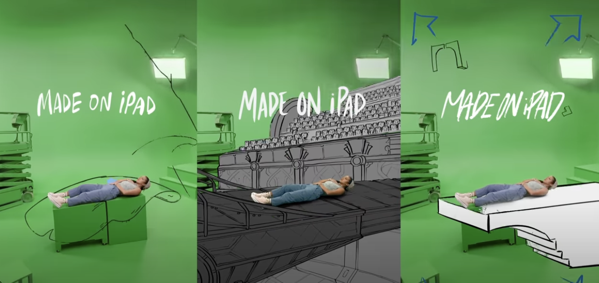
This new ad shows off what the new iPad Pro’s can do featuring three different artists creating three different backgrounds while actress Sofia Wylie dances around in front of a green screen. Even the Apple Pencil gets some screen time.
Here’s the new ad called Worlds Made on iPad. Better to make than crush.
You can find more of my writings on a variety of topics on Medium at this link, including in the publications Ellemeno and Rome.