I’m kicking back this Memorial Day weekend and reading a bit less on the Internet. So this Sunday Morning Reading edition doesn’t feature articles of interest. Instead it features links to a few folks I follow for their writing and creativity. I’d recommend you take a look at their stuff as well.
Stan Stewart is a musician, poet, and does some nice photoraphy on his site Muz4Now. He’s always putting out something worth your time.
David Todd McCarthy is a writer I’ve come to know since jumping on to Mastodon last year. He’s opinionated, always fun, and occasionally infuriating. But you’ll come away glad you walked in the door. You can find him on Medium.
Jason Kottke is one of the original bloggers from back in the day when everyone was asking what a blog was. If you’re looking for something/anything that might pique your interest, you’ll certainly find it at kottke.org.
If you’re interested in tech, especially Apple tech as well as some interesting takes on some cultural things surrounding us, you might want to check out M.G. Siegler on 500ish.com.
If you’re interseted in just what the heck Sunday Morning Reading is all about you can read more about the origins of Sunday Morning Reading here.
Apple is releasing iPad versions of its Pro apps, Final Cut Pro and Logic Pro this week. For the uninitiated “Pro” is typically code for an expenisve, full featured app for professional users. Final Cut Pro for the Mac runs you $300. Logic Pro will set you back $200. It’s an investment.
Users have wished, requested, and even demanded that Apple release iPad versions of these two apps for Apple’s top of the line iPad Pro line. Heck, many even point to the lack of native iPad versions of these apps as proof of Apple’s lack of committment to the iPad. So, on May 9th when Apple announced that these two apps would be available for iPad Pro users on May 23 there was a rush of excitement about the release and also a hesitant holding of breath while examining the pricing.
That pricing, while lower than the Mac versions, ushered in a new era for Apple’s own apps: Subscription pricing. That raised some grumbles of discontent that Apple was releasing these two long awaited apps and for the first time using subscription pricing. Each app will be available for $4.99 a month or $49 a year. There’s also a one-month free trial.
The grumbles come from a lot of folks who don’t like the app subscription model. Some are quite vehement about it. For that crowd paying an annual or monthly price to use an app seems a bit too far. And since subscription pricing became more and more predominant there have been complaints from many users who don’t like to see an existing app that may have once been free, or purchased for a one-time cost go down this path. There are arguments aplenty on all sides of this issue. I’m not going to rehash any of those here.
Admittedly when subscription pricing for apps began to take hold I went back and forth on whether this was a good thing or not. But then after a few apps I use religiously chose this path I began to reframe how I thought about subscription pricing.
Where my thinkng landed rested on two points.
First, the value proposition: If I’m paying $X.XX a month for an app does it provide value to me? If yes, subscribing was no big deal. If not, it was easy enough to not subscribe or cancel.
Second: If this was a new app that looked promising, Apple’s App Store policies make it easy enough to try out the app and then cancel the subscription if it doesn’t offer enough value to reside in my toolbox.
Along the App-ian way of subscription pricing we’re starting to see some apps offer a free trial period. Typically they aren’t as lengthy as Apple’s one-month trial for these two apps, but generally they provide ample time to avoid committing if you’re unsure. Even so, signing up to test a new app for a month isn’t going to break my bank. Your bank balance may vary.
Extending these thoughts a bit, there’s another advantage to subscription pricing. That comes in measuring the success and potential future of an app for the developer. If enough users subscribe in the initial rush on a per-month basis and then choose to unsubscribe after the first month or so, the developer of that app should have a pretty good idea of the marketplace for the app going forward. Some users won’t try the app out until later, but I would think that after six months or so a developer should know whether or not to continue to commit resources to an app or not. It’s like up or down voting on an app but using your dollars to do the voting.
Of course using dollars is an important choice for users. Subscription fatigue is a real thing. So are budgets. And in the case of trying out new apps there are some things to think about.
1. Don’t sign on for an annual subscription, even though there is typically a discount for doing so. Use the month to month option if you’re trying things out. Sure it costs you a little more per month, but you maintain your flexibility.
2. Just know that app subscription pricing like any other type of subscription (streaming services in particular) or other monthly services (utilities, etc…) the price is eventually going to increase. It’s like taxes and death. It’s a given. When you hear of a price increase, it’s a good time to reexamine the value you’re getting out of the app.
3. Don’t wait until the end of a subscription period to cancel the app subscription. Once you’re sure the app won’t be something you want to keep paying for, cancel the subscription. If you’re unsure but leaning against keeping the subscription you’ll still have a portion of the month you subscribed in to test out the app.
4. Just like with media streaming services if you need an app for a specific job or not you can subscribe and then cancel. No one is going to turn your money down if you need to resubscribe in the future.
The bottom line for me is I’m not hesitant to try out apps with subscriptions if they are on the App Store.
Earlier this month I posted about iCloud issues preventing a number of services from working. The issues continued to plague me and other users. Apple support personnel had no answers and dealing with them proved…well let’s just call it less than satisfactory.
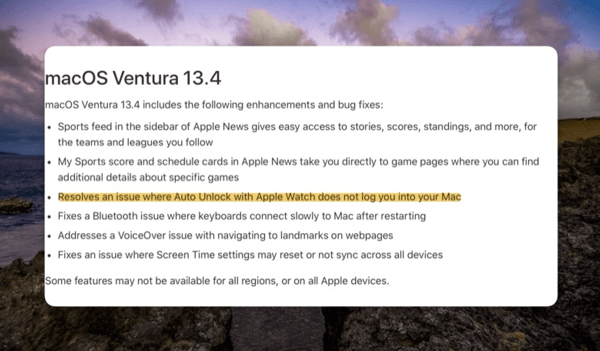
Apple recently released updates to all of its many devices on May 18 and lo and behold included in the release notes was this little gem.
Hope? Relief? Too early to tell. Losing the ability to sign in with an Apple Watch was usually the first indicator something was wrong. As mentioned in that earlier report this seemingly random disconnecting from some iCloud services was just that: random. And though I pinned the issue on a previous series of Ventura updates it didn’t manifest until few days after I had installed the updates.
So I installed these new updates and crossed my fingers. For a day things seemed fine. Two days in though the problems resurfaced on the MacBook Air. A reboot has so far solved that. (There had been multiple reboots since installing the latest updates.) Three days in the issues returned to the iMac. Again a reboot seems to have solved things. For the moment.
We’ll see how things roll going forward, but I’m guessing this isn’t solved yet. Neither are Apple’s support issues. Which is another story for another day.
Some Sunday Morning Reading to share. If you’re new to this now regular feature on Wicked Stage, you can read more about the origins of Sunday Morning Reading here. As always, it’s a varied collection of links. Some I find fun. Some informative. Some just weird. Regardless they caught my attention and I hope they catch yours.
The Debt Limit is Just One of American’s Six Worst Traditions. Lots of talk about the US Debt Limit debate at the moment. Here’s a look from John Schwarz and others at The Debt Limit and five other silly/stupid/bad political traditions in the US. Bet you’ll learn something from this one.
Apple announced some very interesting new accessibility features coming later this year. John Vorhees of MacStories did an interview with David Niemeijer of AssistiveWare, a company that makes augmentative and alternative communication apps for the iPhone and the iPad about how these kind of features can beneift real-world users.
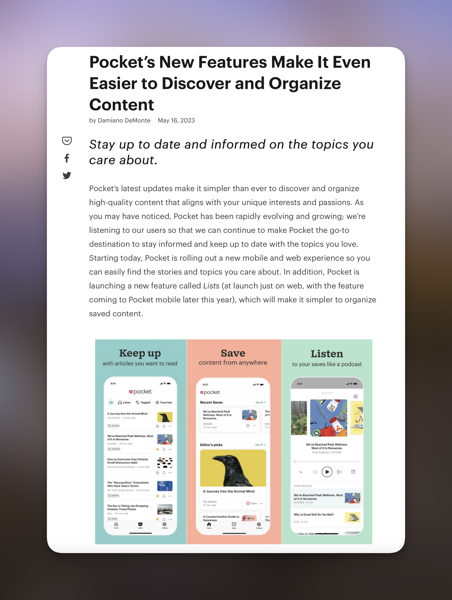
Damn. I hate it when this happens. An app that has been a useful part of my Internet dance routine decides it’s time to join the algorithm dance party so it can recommend “things I might like.” Pocket, an app that has long been one of my partners has sashayed onto that crowded recommendation engine dance floor. Which essentially means it will eventually disappear from my dance card.
Pocket began it’s life as an app called appropriately “Read It Later.” It’s flirted with all sorts of changes along the way, adding a paid premium version in 2014. Pocket was integrated into the Firefox browser awhile back and then acquired by Mozilla in 2017, Up to now Pocket has avoided the lure of the recommendation algorithm dance party. But no longer. They began rolling out this change to Android users In January and are now introducing it to iOS users this month.
Pocket works on all of my devices so when I see an article I want to read I use an extentsion to save it to Pocket so I can read it when I have the time and on the device that is most convenient when I find that time. I’ve been using it for quite awhile and it is at the top of my Billboard Top 10 list of apps I install on a new device.
To be fair, many apps end up chasing new dance partners. In order to keep paying the bills the money has to come from somewhere, whether it be advertising, raising prices or venture capital. At the moment there is still a free version of Pocket. So the origins and functionality of the service still exist.
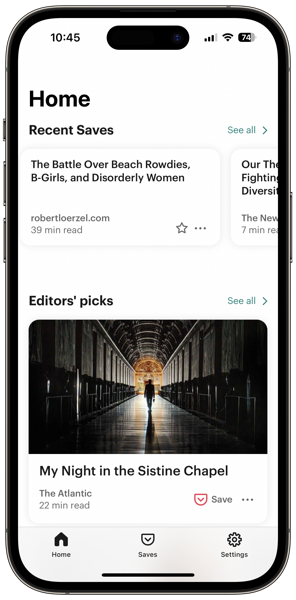
Here’s my complaint. Pocket is turning into a recommendation engine first and deemphasizing the “Read Later” functionality. All you have to do is look at the new UI on a mobile device and while “Recent Save” is at the top, the page is designed to take you to “Editors’ Picks.” Those “Editors’ Picks” are curated. Call me cynical, and probably unfair, but I’m guessing that curation is done by algrothim. Call me even more cynical but when a service tells me that it is making a change to provide me with “topics you care about” I translate that into “links that serve the service first and not the user.”
Be honest. Do you actually rely on recommendation engines? Sure, occasionally they’ll surface something of interest. But in my experience they mostly serve up more of the same the way that Amazon and streaming media services do. Like a bad DJ who doesn’t know how to keep the mix fresh and exciting and just spins the same old same old. I can’t begin to list the number of apps I once used that have danced their way into an uninstall this way.
It’s not an original dance step. It’s become a tired one. Sure most love to hear the DJ spin up “The Chicken Dance” at a wedding. But do they actually put it on their own personal playlist? By and large, while it may increase revenue (again not a bad thing) in the short term I’ve yet to find an app or a service in this drunken conga line that I don’t at some point scratch from my dance card. Bluntly, I could care less what Pocket’s “editors” think I should see, or what other users think I should see.
Obviously nothing lasts forever, especially in Internet years. But I’d love to see this dance party be one that wears out its welcome sooner rather than later.
In the wind up to Apple’s World Wide Developers Conference for Apple to release news of upcoming new impressive technology focused on Accessibility issues around Global Accessibility Awareness Day. This year is no different.
Apple’s press release highlights the new features for cognitive accessibility, Live Speech, Personal Voice and Point and Speak Magnifier. You can read the press release here.
While each of the advances are more than worthy I was particularly impressed reading about Personal Voice. Here’s an excerpt from that release:
For users at risk of losing their ability to speak — such as those with a recent diagnosis of ALS (amyotrophic lateral sclerosis) or other conditions that can progressively impact speaking ability — Personal Voice is a simple and secure way to create a voice that sounds like them.
Users can create a Personal Voice by reading along with a randomized set of text prompts to record 15 minutes of audio on iPhone or iPad. This speech accessibility feature uses on-device machine learning to keep users’ information private and secure, and integrates seamlessly with Live Speech so users can speak with their Personal Voice when connecting with loved ones.1
Personal Voice allows users at risk of losing their ability to speak to create a voice that sounds like them, and integrates seamlessly with Live Speech so users can speak with their Personal Voice when connecting with loved ones.
“At the end of the day, the most important thing is being able to communicate with friends and family,” said Philip Green, board member and ALS advocate at the Team Gleason nonprofit, who has experienced significant changes to his voice since receiving his ALS diagnosis in 2018. “If you can tell them you love them, in a voice that sounds like you, it makes all the difference in the world — and being able to create your synthetic voice on your iPhone in just 15 minutes is extraordinary.”
I’m reminded of the time when noted film critic Roger Ebert, who lost his voice due to cancer, made quite a stir with news of how he was using a synthesized version of his voice to communicate. It was big news then. Apple’s Live Voice seems like it has the potential to make that kind of thing more accessible to many more.
Check the end of this post for updates. Soon after I posted this the issues popped back up. The saga continues.
Oh, Apple. You make it sound so easy. Can’t sign in with an Apple Watch? Devices having syncing problems or lose connectivity to the Continuity/Handoff magic? Sign out of iCloud and then sign back in. Problem solved? Sometimes. For a time. Not every time.
Signing in and out of iCloud to fix issues can create random headaches as nasty as a migraine. You never know when those migraines are going to hit. You live life a bit on edge anticipating and dreading the next reccurence. You know it will happen. Or you fear it will. And when it does hit, well you know what’s coming.
I haven’t blogged about things Apple in awhile. Not since this post on Apple’s Design Trap. But it feels like my pace might pick up a bit given the frequency of new kinks I’m experiencing in the Appleverse. Funny, not funny, how these migraines seem to surface in the run up to Apple’s annual new operating system announcements at WWDC and then continue throughout the summer. It almost feels like whether we sign up for betas or not, we’re all along on the summer beta bus for the ride anyway. Especially if we take advantage of the number of services and features connected to iCloud.
Yes. iCloud. Troubled when launched, it is less, though still troubled now. But though it may be less, it’s actually become more mysterious because it’s tied to so much more than when it had its troubled beginnings. When I say mysterious I’m not just talking about how users feel. Talk to an Apple Support rep about an iCloud issue. Beyond advising signing out and signing back in they are by and large as confused by the mystery as the rest of us.
Here’s the story.
I’m a big Apple fan so I come at my criticisms of Apple from the point of view that I enjoy and prefer Apple’s devices and software. I use a variety of Apple’s computers and products. I also subscribe to iCloud via AppleOne. I like to take advantage of quite a few of the features that require an iCloud subscription to benefit from such as Sign in with Apple Watch, Universal Control, Handoff and Continuity. Prior to last fall’s release of Ventura, iOS16, watchOS9, etc.., iCloud would somehow randomly bungle things up so these features would just stop working. Typically you don’t know that things have stopped working until you go to use one of the features. The problem(s) seemed to be resolved after the Fall 2022 releases of those new OS’s. But as we all know Apple keeps working and releasing updates throughout the year.
After this past spring’s release of Ventura 13.3 the problems appeared again. After the release of Ventura 13.3.1 I didn’t see any of these random cock-ups and dared to breathe a sigh of relief. Premature as it turns out. Even though there were mutliple device categories involved in the 13.3/16.4 round of OS updates I’m pinning this on Ventura because in attempting to track problems down I discovered that there were no issues with any of these features between iPads and iPhones. Turn off the Macs and things worked as designed. Call me crazy but “Turn off your Mac” sounds slightly worse than “you’re holding it wrong.”
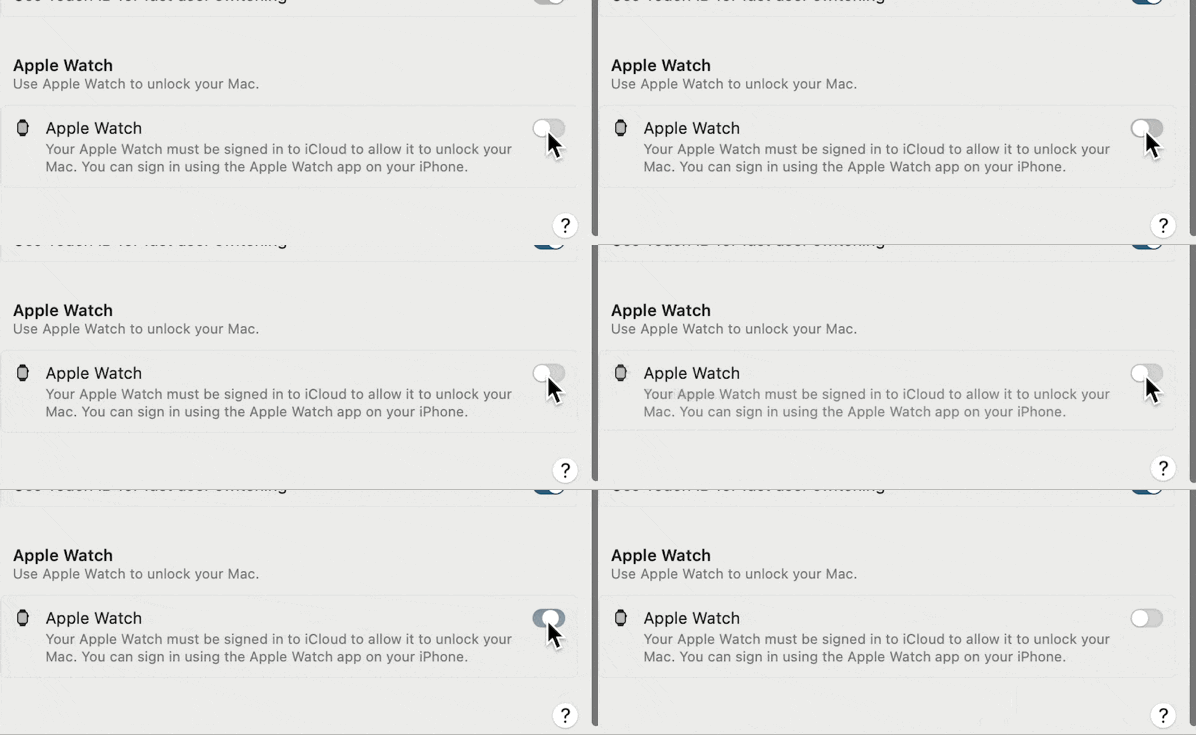
Coming back to either of my Macs (MacBook Pro M2 and iMac 24) I could randomly no longer log in with my Apple Watch. That’s a first world problem I know, but hey, it’s my first world so it’s a problem for me if not for any substantial number of users. And of course the error message Apple offers is about as helpful as warm spit.
For those that don’t know there’s no place to “sign in” using the Apple Watch app on your iPhone. To sign out of iCloud on your Apple Watch you actually have to sign out of iCloud on your iPhone and the reverse is true. So this little not so helpful message should tell you to sign out of iCloud for your iPhone. Oh, and the clever little animation in the above GIF is showing the enjoyable experience I would receive when I tried to toggle the control that lets me sign in with my Apple Watch. Top notch support and design. All around.
Once I arrived at this goodness I would then check to see if any other of the Continuity/Handoff features would be disabled and of course they would be.
Consistently Inconsistent
Now here’s the bigger problem. There’s no consistency to the failures. Sometimes the problem would be on both Macs and sometimes on one of the Macs, (it seemed like they were taking turns). Once I rebooted the MacBook Air to attempt and resurrect the lost iCloud features connection and in that case I had success. Only to see that the connection on the iMac had failed in the time it took to reboot the MacBook Air. In almost all instances there was nothing out of the ordinary added to either machine (that I’m aware of) or me using the machines in any new or different way. Other than an operating system update. (*cough*)
Prior to Ventura I had talked with Apple Support and scoured online sources for solutions when this problem would manifest. There were and are as many guesses to solve these problems as there are people looking for answers. Everything from rebooting to rebuilding your device(s). The same is true in this current moment. In some cases a reboot solves the issues. In some cases not so much.
Others solve it with any number of solutions (Bluetooth on/off, logging a user in and out, etc…). Most who get to the point of logging out of iCloud report some success, only to see the problem come back at intervals ranging from a couple of hours to several days.
Currently I’m in that latter “several days” category. It’s almost consistent at three days. Occasionally sooner. Occasionally longer. The range of unpredictability is at least narrowing. But the bottom line here is this: Apple has no idea how to solve this issue.
So there’s a problem. I can only conclude that it’s related to iCloud and something introduced recently in Ventura that affects Macs given that everything seems to work when the Macs are turned off. Signing out and back in to iCloud will solve it. For awhile. That’s the current state of affairs.
What Apple and those who leap to the “Sign out of iCloud” as a solution to this migraine-like nightmare don’t tell you is the potential series of after shocks you’ll encounter along the way back.
Apple does provide a handy list of the services you’ll lose access to when you sign out of iCloud at this link. And when you decide to take that step Apple will also let you know that you’ll lose any credit cards you have set up with Apple Pay. Apple will also give you the option to save some iCloud data on your Mac. But that advice doesn’t cover what you may or may not have to do to get things back up and running the way you want it to. These are some of my experiences:
Things that happen each time I’ve logged out and back in to iCloud.
First, if you happen to use different Apple IDs for purchases/music and iCloud you’ll have to manually reassociate your purchases/music ID with your iCloud account in the same way you do when you set up a new device. I know I’m not the only old geezer who first got an Apple ID back in the day when I used iTunes and an iPod with Windows, so I’m sure others will have to do this as well.
Second, if you use iCloud Photos and have chosen to save originals to your Mac, you’ll have to make that selection again in the settings for Photos. If you do have to reselect this Photos setting that means you’ll burn bandwidth downloading those originals again at some point.
Third, if you’ve downloaded some music to your device you’ll have to redownload those selections again. Again, Apple doesn’t seem to remember what you’ve downloaded previously.
Fourth, As expected all of your Mail, Notes, Reminders, Calendars, and Contacts have to be redownloaded. (More on Contacts in a bit.) This seems to work relatively quickly with the exception of Mail, Notes, and Contacts which can take some time depending on what you’ve accumulated.
Fifth: Apple does warn you that you’ll lose credit cards in Apple Pay. So you know that going in. Having to go through this process so frequently in recent weeks unfortunately flagged my account at my bank necessitating a phone call to explain what was going on. So I’m not re-adding that card back to Apple Pay until or if this problem settles down.
Things that happen sometimes and sometimes not when I logged out and back into iCloud.
Messages: I’ve got several group threads I hide notifications from. I sometimes have to “re-hide” those notifcations. Sometimes not.
Airpods and Bluetooth: I don’t choose the default Airpod setting that allows Airpods to connect to a Mac automatically. I use the “When last connected to this Mac” setting. That setting sometimes holds and sometimes does not.
The image I use for my avatar on my login screen sometimes comes back as normal. Sometimes not.
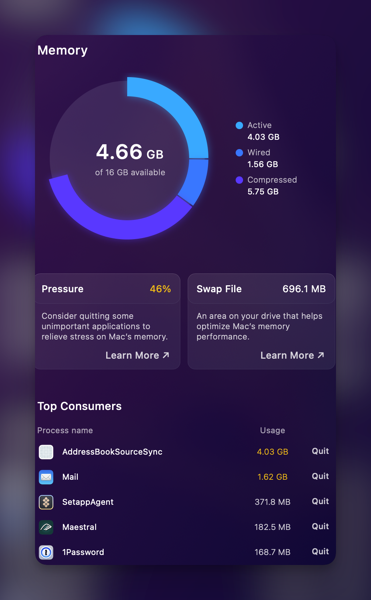
Contacts: I mentioned that earlier. On some, not all, occasions Sign Out/Sign In Contacts seems to want to rebuild it’s database completely. I only noticed this after one of these episodes when for the first time my M2 MacBook Air got hot to the touch. In trying to figure out the problem I noticed that the AddressBookSourceSync was the culprit eating tons of memory and processor time. Again, this didn’t happen each time, but it did happen multiple times on each Mac. Note: I hardly ever use the Contacts app on my Macs. Typically any contact I add or change comes from my iPhone.
Various other settings and preferences seem to come and go. But again, it’s not like I use everything on my Macs every day so who knows when in this cycle of logging out and back in something changed or didn’t.
I get the problem here. Apple has created quite an intricate and appealing series of services that rely on iCloud as a backbone. When things work they work great. But they don’t always just work. Advancing these services and features requires constant development and there’s no real way to make sure every possible detail and permutation is locked down and working on the annual pace that Apple rolls out these operating systems. So, there will be problems. Bugs. Issues. Headaches. Call them what you will. Fix them and move on.
But, if things are moving so fast that your support personnel and documentation can’t keep up then it might be time to re-evaluate the pace. The misleading “fix” in that message in the animated GIF above has been around for at least two generations of Apple operating systems. Frankly at this point, it’s insulting.
iCloud woes date back to its inception. I doubt they will ever truly be solved. But at least give users and your support personnel information that makes sense, explains what your fix may or may not do, and isn’t misleading or sounds ignorant.
Updates: A few hours after posting this the issue happened again after being away from the iMac 24 for a few hours. Nothing going on just the computer normally going into Sleep Mode. As had happened once before, all was working on the MacBook Air until I rebooted the iMac. And then the MacBook Air took the same iCloud dive.
The reboot of the iMac 24 was successful and brought things back on that device. I’ve rebooted the MacBook Air 4 times now and still no luck on that device. That typically means I’ll have to sign out and back in to iCloud. I’ll update again after doing that.
Update 2: Wednesday. I logged out and back into iCloud last night. After the requisite time of letting things settle back in most things that I checked seemed to be working again. Until they didn’t. This morning I tried to open MacBook Air while having coffee and none of the features were working again. So far everything at the moment seems viable on the iMac 24.
Two more reboots of the MacBook Air seemed to right the ship.
Update 3: Thursday. Ran some errands for a few hours today. Returned. Neither Mac would accept Login With Apple Watch and all of the attendant other problems. Rebooting both machines yielded a return of things to the MacBook Air but not the iMac 24.
This is getting old.
*For a variety of reasons this post has been in the creation process over a couple of weeks. During that time the issues I discuss occured mutliple time on both Macs. I anticipate they will continue.
Every day is a good day when you learn something new. And this amazing story certainly offers something new to me.
TropeTrainer was software that had been taught to sing the words of God.
Then it went silent.
A developer created TropeTrainer, software that helped prepare kids for their bar and bat mitzvahs. He passed away. Due to advances on computers his software abruptly stopped running on new or updated computers and much was lost.
Most magical was the voice synthesis, which featured an adjustable timbre and a playback speed, Buchler boasted on his website, that could be set “from unbearably slow to comfortably fast.”
In a wink to exasperated Torah tutors, he devised the slogan “Software With Infinite Patience.”
That brief description and excerpts here risk trivializing this story. So, go read the story.
The world is continuing to rush headlong into a new universe of Artificial Intelligence but apparently I died before the gold rush began.
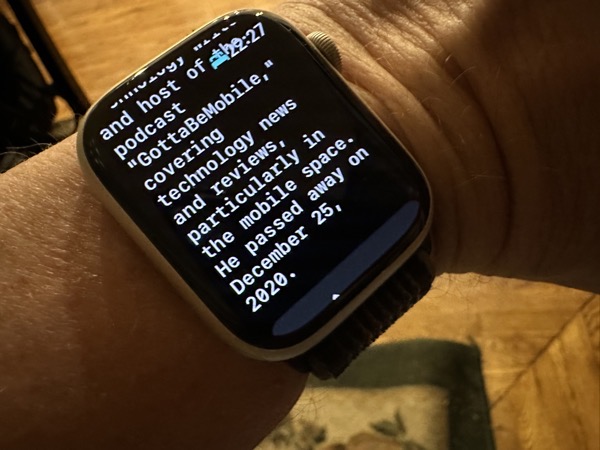
At least that’s what WatchGPT an OpenAI based app for the Apple Watch thinks. I decided to give it a try and asked it a simple question: Who is Warner Crocker?
After explaining it wasn’t a search engine it spit out some “facts” including that I died on Christmas Day 2020. I must have missed that.
Although my demise sounds pretty factual I’m still hanging around as far as I know. And sure the years since December of 2020 were kinda sketchy due to the pandemic, so far I have avoided COVID and other life threatening adventures. The cast for my current gig seem to respond to me as if I’m alive and kicking. My family and friends still treat me like I’m walking around and causing trouble.
Granted most of these AI products let you know that they’re still in development. Still, I can imagine quite a few scenarios where folks input a query and get death notices that then get reported as facts in whatever vehicle they’re looking the fact up for.
Let’s list a few flights of fancy here:
A school paper on a contemporary figure.
Checking out info on someone you might want to date.
Running a check on a perspective employee or employer.
And to think, big companies are jumping into this pool feet first assuming they will be able to save money by cutting their workforce.
I’m wondering if my wife can use this to make an insurance claim?




 Be honest. Do you actually rely on recommendation engines? Sure, occasionally they’ll surface something of interest. But in my experience they mostly serve up more of the same the way that Amazon and streaming media services do. Like a bad DJ who doesn’t know how to keep the mix fresh and exciting and just spins the same old same old. I can’t begin to list the number of apps I once used that have danced their way into an uninstall this way.

 Life on the Wicked Stage: Act 3